Showing posts with label sidewheeler. Show all posts

Wednesday, March 20, 2019

FRANCIS SKIDDY c.1852 - A Hudson River Legacy...Part Two/ Rex Stewart

   
                            Starboard bow profile highlighting the Union and American flags as
                            they appeared on the FRANCIS SKIDDY during her maiden voyage
                            that summer of 1852.


My work has always been regarded by many notables for being historically accurate; particularly those steamboats that operated throughout New England and the much-heralded Hudson River Valley. In my line of work, I feature this prolific model that I modified from plans originally drafted in 1985.

This second part series focus on both the build and the vicinity where the collector of this model resides. There's no question he has amassed some of the most accurate steamboat models in the Hudson Valley today. But what strikes me as 'intriguing' is his timing in acquiring them and his effectiveness in showcasing quality pieces that many New York State museums don't have in their collections.

As a native New Yorker, born and raised in Albany, New York, I was fortunate to become part of the maritime fabric relative to both Hendrick Hudson's HALF MOON design and the steamboats that operated on the Hudson River. In both genres I realized I had the opportunity to explore and expand my research -associating with those who had strong and affluent ties to the river. Over the years, because of this association, I became connected to various towns and cities up and down this waterway -with Newburgh being the latest discovery to the list.                                                                                                                                                                                                                               
 

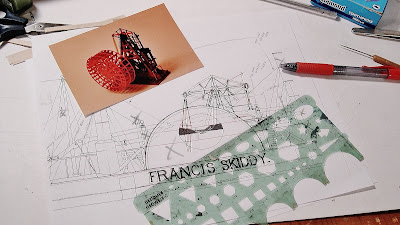
                     Plan modifications revised in red ink for those highlighted areas concerning the
                     hogframes, smokestacks and trusses. Also modified were boilers from photos I
                     used relative to the Kingston steamboat THOMAS CORNELL.


.

                            Close-up view featuring opened sliding door (starboard) at saloon cabin
                            with rigged lifeboat...Inside, I made custom patterned carpeting to simulate
                            a detail commonly featured on these vessels during those times.

Much talk traveled on the river from New York City to Albany, New York during the 1840s about a massive steamboat that would soon join the fleet of heralded steamers operating on the Hudson. Many businessmen, and mariner alike, were contemplating this vessel. It would be the first of its kind anywhere.

At the shipyard of George Collyer in New York City, the keel was laid in 1850 for the large dayboat. The following year, under the scrutiny of draftsmen, businessmen and investors, the wood hull and superstructure began to take form...FRANCIS SKIDDY was now becoming a reality.


                        In this photo the author carefully inspects the detail about the paddlebox
                        which include the miniature mural painting of the Hudson Highlands.


FRANCIS SKIDDY began trips in June of 1852. She was a steamboat of meticulous design and grandeur -the largest and finest vessel of the period. By all standards she was considered the zenith of steamboat architecture and the first four-stacker to make such an appearance. Her cabins were spacious -being finished in polished mahogany for which steamboats of this era was noted. The main cabin was in the hull, extending the entire length; and dining tables were made to seat 500 people.

Aside from these accommodations, FRANCIS SKIDDY was a dayboat which meant speed was a dire factor for her success. She made good on her performance between New York City and Albany by arriving at six landings on the 146 mile route in a record 7 1/2 hours. Her travel started from New York in the morning to Albany -returning back to the city at night.


                   Starboard deck overview show completion of hogframe, tierod and smokestack
                   piping systems...Also on this deck between the paddleboxes, a small portion
                   of the roof is left unpainted. This area will house the A frame that will
                   support the walking beam engine and its various pistons and crankshaft.
                 

                      The author's detailed replica of the FRANCIS SKIDDY walking beam
                       engine based on the plans provided by the late Everett C. Britz. He was a
                       New York businessman and avid collector of steamboat memorabilia. The
                       plans for this engine were drafted by the students of Rensselaer Polytechnic
                       Institute when the SKIDDY was docked at Troy, New York as a nightboat.
                       Mr. Britz served on R.P.I.'s college board during the 1980s and remained
                       a serious collector of my models; one, being this piece he commissioned
                       in 1987.


Those who witnessed this awesome steamboat, whether shoreline or in river passing attested the fact that she was very spacious and a fine craft in artistry. Her performance was first rate as a large vessel. She was wide and long. Her length was 322 feet and she carried a hull beam of 38 feet. Her depth of hold was 10 feet and 4 inches while her water draft was listed as 5 feet 6 inches.The large vertical beam engine she housed was built by James Cunningham and Co. Her four impressive boilers and 40 foot paddlewheels which carried 24 buckets to each wheel were built by John F. Rodman out of New York City.

For a period of three years FRANCIS SKIDDY operated as a dayboat, being celebrated by artists and writers, alike. She was a favorite to the general public. However, her career was short-lived, as she was removed from service and greatly altered to become a nightboat. Instead of Albany being her upstate port, she was docked further north at Troy, running at different periods with the steamboats COMMODORE, HENDRICK HUDSON, RIP VAN WINKLE and C. VANDERBILT.

On the night of November 5, 1864 while travelling southbound, she ran ashore at Staatsburgh and sunk. The hull was later broken up and the engine was placed in the new steamboat DEAN RICHMOND which docked at Albany.

Here, we have a history concerning one of the great steamboats of Hudson River lore, but equally exciting, we now have accurate models that depict how these vessels appeared in their heyday of service. The remaining data of my contribution to this history is not to rewrite what was already written; but rather take the history of these vessels to another area that has rarely been touched. That area are these one of a kind replicas which have rarely been seen in the collectibles market.


                             View of the hurricane deck from port stern as the model progress.


                     Another port view from the stern showing the interesting and symmetrical designs which was typical for many large steamers of the day; especially the tie rod and cable patterns about the hog frames, stacks and masts.     


                                             Closeup detail of the stack, flags and cables...                                           

                               
                       Finding the detail work satisfactory in both construction and finish of the
                       hurricane deck, I proceeded to work on the miniature lifeboats (to scale) 
                       from a solid piece of pine -using my custom templates to assist. Notice the 
                       miniature oars on top of the Kennedy half dollar.


                   My next approach was the pilothouse, but only after inspecting and evaluating
                   the saloon deck details. As with all the superstructure, carving panels around the
                   windows was painstakingly time consuming. Most challenging was to avoid
                   cutting too deep into the wood -as this would cause paint to seep into the crevice
                   and mar the simulated windows.


                                                  Detail close-up of finished pilothouse...


                The next step of the build would now be the walking beam engine which would
                be the final finish to the project -and one which is most tedious due to all the small 
                pieces required to make it. Here, I re-work the plans so that the positioning of the 
                engine is accurate. And since it will be entirely of wood no error can be made.


                     Shown is the work in progress of the A frame and completed engine.                                 


The beginning process showing the finished steam valve system and the early build of the
          cylinder piston rods for the engine.                                                                                         


                                  The A frame takes form...                                                                                                                                                                                                                                                                 
   
                                     Port view close up of finished walking beam engine.                                          


                  Deck view of beam engine from starboard. The complete build of this intricate work 
                       took approximately five days.                                                                                             


Head-on bow view showing the beauty and sleekness of steamboat FRANCIS SKIDDY during her first appearance in 1852. One could only imagine what people saw when she arrived and departed  from those landings.                                                                                                                                                  


                       Another head-on bow view (from starboard) of the FRANCIS SKIDDY.                         


                         Steamboat model FRANCIS SKIDDY c.1852 - port profile overview                            


                         Steamboat model FRANCIS SKIDDY c.1852 - starboard profile overview                  

As I'm about to come to a close, I reflect on how many have supported my work over the years. I have been very fortunate to meet outstanding individuals who have given me the best of their hospitality, friendships, and references. My gift to them (and others) have been to pay it forward by remaining in this genre. Again, I've said it many years ago; and I continue to say it "that we are not islands, but people who need each other for the betterment of one another." So is the case here.

There are a few more images to post, but I must give a thumbs up to Newburgh, New York and the stellar hospitality I have received from the collector who commissioned these works. A thumbs up to those from that area who provided great service to us at their waterfront restaurants. To the law enforcement officer that assisted my personal and professional pursuits via social media; and lastly, to several historians who unselfishly shared their expertise on the city and region relative to it's maritime and citizens. This has been a great 40 year journey... Not just with commissions, but in the projection of knowing we have a Society that still appreciate history -at all levels and all genres, especially the maritime.

Now to close with the remaining images...


         Francis Skiddy painting dated 1859 by noted maritime artist James Bard. 
        Many of my  steamboat models were fashioned around what available paintings 
     were attainable to assist my blueprints. Because of my drafting skills (which I 
      developed as a teenager), former curators and antique dealers considered 
      such plans to be the most accurate and the best in New York State.                                                    

                       Port profile based on the above image of the 1859  Bard painting.                                     


                      Starboard profile (in reverse) based on the James Bard painting.                                      


A view looking south through the northern gateway of the Hudson Highlands from the waterfront pier at Newburgh, New York. The pier which runs along the revitalized commercial area of the city, has a unique array of restaurants that host fine food and people. It bustles year round -as this photo was taken by our daughter, Rexavia, during a brisk late morning in January. We were there to deliver the steamboat model to the Collector.

The Hudson Highlands is the feature painted on the paddleboxes of famed steamboat FRANCIS SKIDDY. This location of waterfront accommodated the citizens with both ferry and steamboat service of which the SKIDDY was one of them.


                   Window view from the Collector's home showing the town and hills of Beacon,  
                New York. With the beautiful steamboat paintings he has to accent the models, this 
                view is honorable.                                                                                                                      


                          Library Parlor... 

Here, in between the sitting area are featured two prolific steamboats I built while residing in New England. On the east bookcase sits the renowned steamboat ALBANY as she appeared when first built; and on the west case the MARY POWELL is featured -also in her original livery... Throughout his home, these thoroughly researched (and carefully planned) models accent areas where the visitor will follow the history of Hudson River steamboating from its early years to its final closure with ALEXANDER HAMILTON. 


                                          Midship view details from starboard...                                                              


With each commissioned model, I'm always asked to provide a custom case. Usually, my cases are made with simplicity. The case should never be so attractive that it 'fights' with the model. The case is there to protect it and keep the model as the 'showcase'...As a result of this principle, my clients have chosen to work with me -and their colleagues work with me because they view the model and lose themselves in the details...as it should be.


When custom making my cases, I also produce my own stains...something I learned while exhibiting in the antique venues at Brimfield, MA years ago. My work is contemporary, but much of it carry the 'antique' flair which accent a unique blend of presentation which is "traditional -contemporary". My models fit into this category, along with my sculptures. Also, many of my past work carry handscripted  wooden plaques as shown in this image.                                                                             


This concludes the blog on FRANCIS SKIDDY. I appreciate my viewers and look forward to presenting more subject matter on those prolific steamboats that ran on our Hudson River. Again, I relish the fact that I can still produce them in my maturity...thanking all of you for being part of the legacy. 

Commissioned work can be honored for any and all Hudson River steamboats. These are fine, one of a kind models that accurately define the vessel as it appeared at any given time of its career. For information please email Caseships@yahoo.com or call 1-774-757-7137 for details.

To view my work and credentials please visit https://youtube.com/c/RexStewartoriginals 

Thank you for viewing!


Tuesday, May 29, 2012

Researching HIGHLANDER c.1835 - The Model/ Rex Stewart

             
           Samuel Ward Stanton's drawing of the famed Newburgh, New York steamboat
           HIGHLANDER as she appeared on the Hudson River in 1835.


Newburgh, New York was a booming river town that developed into a monopolized commerce
center for the citizens of the Lower Hudson Valley. Much freight, especially produce and livestock was going south to New York City and steamboats were needed to get those goods to its destination. Furthermore, travelers who needed to commute to various towns found these vessels accommodating for the purpose. This was the era of the 19th century and river commuting was the beginning of a new form of travel.


             Early brothers Bard watercolor depicting HIGHLANDER's 1835 appearance.
           Both renditions had to be carefully studied for accuracy and proper re-configuration
           in order to build an accurate scale model.


While researching and building steamboat models in New York's Capital region during the '80s and '90s, I was fascinated with the discoveries I encountered concerning steamboat designs of the 1830 period. I had built models from the 1840s to the present, but never considered those vessels built past Robert Fulton's CLERMONT.

Many contemporary builders had no knowledge of these early sidewheel types, so no models were available to work from -let alone, plans. Only one such work existed on an early steamboat of this period and that was produced by noted modelmaker Forrest Van Loon Ryder out of Coxsackie, New York during the 1950s. This model was HIGHLANDER, one of several Hudson River steamboats he built for collectors, museums and those interested in these prolific boats.


             A vintage model of HIGHLANDER built by the late Forrest Van Loon Ryder
             which is now on display at the Captain David Crawford House Museum in
             Newburgh, New York. There, five other Ryder models are exhibited; all at
             1/8" = 1' Scale.


In 1980 I was commissioned to copy Mr. Ryder's MARY POWELL for a corporation which  the model later became a topic of conversation with business executives at the time. I then decided to venture out and research MARY POWELL to design my own plan set relative to having an accurate model enter the Hudson Valley. These soon became highend collectibles of note. However, Ryder was my inspiration from which I drew the ability to explore, research and study the American steamboat -beginning with those that operated on the Hudson River.


                HIGHLANDER c.1835 - profile plan at 3/32" = 1' scale. Research for this
                work was based on the brothers Bard watercolor and Samuel Ward Stanton's
                drawing which included supportive dimensional data of the vessel at the time
                of her construction.


In the Fall of 2011 a colector from the Newburgh Region proposed a line of steamboat models which included HIGHLANDER. This proposition became the anticipated opportunity to finally research and build a true 1830 replica of a Hudson River sidewheeler. With the experience and credentials established over a thirty year period, it wasn't difficult to configure this vessel's appearance.

The client was very specific about his collection. He wanted all three sidewheelers to be constructed at 3/32" = 1' scale which made little room for error regarding hull dimensions, beam width and deck layout.

HIGHLANDER was a walking beam type steamer that carried her stacks and boilers on the guards away from the hull. Knowing this fact made plan drawings easier to develop...and within two weeks I was able to produce some prolific plans (for the first time) concerning an early steamboat. I now had the formula for designing these vintage gems.


               Work-in-progress showing the underside features of HIGHLANDER. Notice
               the early design pattern of the Northeast sidewheeler. Most steamboats of
               this period  omitted bottom rims which secured and protected the paddles. It
               is possible that the paddles, including the wheel system, was made of oak -giving
               way to these buckets being bolted to the stems of the wheels so to allow this
               feature to last several years without rotting.


               Port bow view showing HIGHLANDER's auxiliary flagstaff. upon viewing
               several Bard paintings and Stanton drawings, I discovered that this odd
               apparatus was carried and used to attach company house flags and pendants.


                 Early steamboat models I built during the '80s and  '90s featured handpainted
               flags made of soft metal. These were treated with acrylic base to prevent
               chipping. In recent times I now apply treated paper flags using the same
               applications. However, the paper flags are more life-like, especially when these
               are folded to give a breeze effect.


                  Maritime artist and shipmodel specialist Rex Stewart carefully applies the
                walking beam engine to the HIGHLANDER model. Nearly 140 seperate
                wood pieces make up this detail.


                   Starboard overview illustrates the strengthening process of a steamboat
                 of this period. The blue-colored kingposts, spars and hogframes, reinforced
                 with steel tie rods, were placed in strategic points on the vessel to secure
                 areas where the most strain existed -primarily at the stern and amidship
                 around the paddlewheels. So that this odd structure didn't take away from
                 the steamer's design, the kingposts and spars were adorned with gilded
                 balls and, occasionally woodsculpted eagles.


                  Port profile of Newburgh, New York steamboat HIGHLANDER c.1835.
                Scratch-built solely in wood at a scale of 3/32" = 1'. 


History:

HIGHLANDER was built for the company of Thomas, Johnson and Wardrop in 1935. Her length on the keel was 160 feet with a beam of 24 feet. Her depth of hold was 8 feet and her overall length was complete at 175 feet.

Made of wood, her hull was built at the shipyard of Lawrence and Sneden in New York. The vertical beam engine was constructed at West Point Foundry in Cold Spring, New York. She carried two boilers on the guards; both of iron. Her paddlewheels were 24 feet in diameter with 10 foot length buckets that dipped 29 inches.

This unique steamboat carried a 'cookie-jar' pilothouse on the skydeck with a fancy bell attachment on the roof behind the gilded eagle ornament which sat center. When she entered service on the Hudson River she was one of the best and fastest boats to run. She operated on the Newburgh-New York Line until the steamer THOMAS POWELL appeared in 1846. HIGHLANDER was then used as an excursion boat and later ran for the Freight and Passage Line between Rondout and New York City until 1852. The following year she was taken south to the Delaware River and used as a towboat before being dismantled in 1866. Her engine was erected in the new towboat replacing her which was named WILLIAM H. ASPINWALL.

Commission work can be honored for any and all Hudson River steamboats. These are fine one of a kind models that accurately define the vessel as it appeared at any given time of its career. For information about my line of work kindly email: Caseships@yahoo.com or call 1-774-757-7137.

To view my work and credentials, visit https://youtube.com/c/RexStewartoriginals and https://www.linkedin.com/in/rexstewart.

Thanks for viewing.

Social Share Toolbar

Sunday, November 20, 2011

The Model Steamboat TROY c.1846 - Rex Stewart

Early steamboats that operated on New York's Hudson River were distinctive and had elegant appearances. These vessels, though a part of early Americana, lacked true representation in photos. The camera was not yet in vogue for photographers to capture their appearances, so visual images were accepted by way of notable artists, newspapers, and lithographers of the period.

       An unknown lithograph showing the Hudson River dayboat TROY as she appeared
      in 1840.

Drawings, illustrations and artist sketches and paintings documented close likenesses of these steamers. Lithographs also recorded their structures by way of several printers, one being Currier and Ives out of New York City. From these references, possibilities existed for building an interesting replica. However, much was based on the literature that was written.

Because nightboats greatly differed from the dayboats, to get a better understanding of the TROY, it is written that she was brought out as a dayboat for the Troy-New York Line in 1840...three decades after the War of 1812. Some writings state she was the largest boat in tonnage to appear on the river at that time, and that she had more speed than any vessel afloat.

Viewing three different images, I proceeded in producing a detailed scale drawing of TROY, finding interesting features which I didn't obtain with other vessels built in the Collection. From these features I was able to get a better perspective on the evolution of design and machinery -comparing what was for 1840 to what existed in 1860 which was radical change.
The drawings and lithographs displayed TROY as being a sleek-looking, fast-riding steamboat. With these facts, it was now time to build the model -the only one of its kind in the entire Hudson Valley.


      Port-side profile showing "King Neptune" painted on the paddleboxes of TROY during
      her 1846 season.

The main feature of TROY's appearance were her paddleboxes of 1846. A writing stated she carried a painting of "King Neptune" on them so to make her identifiable from both the river and shore. Also, because there was rivalry between New York City and troy, citizens from both cities were only patronizing vessels from their locales. "King Neptune" was part of the promotional process assisting citizens to identify 'their' boat when she made her runs on the river. She was a river traveler's favorite as a dayboat, but soon was converted and placed on the Hudson as a nightboat in 1848, running in line with the EMPIRE OF TROY.

                  Samuel Ward Stanton's famous drawing of steamboat TROY c.1840 

The maiden trip of this 294 foot steamboat was made July 17, 1840 under Captain A. Gorham. A record run was made the following year from New York City to Troy in 8 hours and 10 minutes which included five landings. During this period rivalry between the two cities was so intense that those cities only supported their vessels. When the EMPIRE was built in 1843, the owners realizing she might be mistaken for an Albany boat, added the words "OF TROY" to the paddelboxes.

TROY was not just a popular boat, but a favorite -even for the Albany citizens who watched her paddle gracefully by. a young John J. Morrisey of Troy, N.Y., served as a deckhand on the boat and later married the Captain's daughter. Morrisey went on to become heavyweight champion of the world and a one time Congressman.


                  Port profile of the Hudson River sidewheeler TROY c.1846, Wood Model

After more than twenty years on the river, TROY ceased running as a converted nightboat.
She was dismantled at Keyport, New Jersey in 1859.

My model show TROY in her 1846 appearance. It is scaled at 1:150 or 3/64"= 1'. As with the other models in the Collection, it is scratchbuilt of pine and basswoods with the spars made of birch. Panel work detail was cut into using a crafters' utility knife.

For more information about commissioning a fine quality Hudson River or Northeast steamboat model email: Caseships@yahoo.com or call 1-774-757-7137. You may also visit https://www.linkedin.com/in/rexstewart


Social Share Toolbar

Sunday, November 13, 2011

Tow Sidewheeler SYRACUSE c.1857


                         Towboat sidewheeler SYRACUSE in New York Harbor c.1877

The Hudson River was a waterway dotted with sail and steam during America's young Industrial Age. Some of the world's most interesting vessels were travelling this river, from sailing sloop to massive nightboat. The river had its own life of whistle, voices and churning water that seem to have echoed every ten to twenty miles from Troy-Albany to New York City. This was the heydey of steamboating.

The towboat entered the river in the late 1840s and established itself as the 'workhorse' of rivercraft.These large vessels were cumbersome in appearance, yet their featured large stack and complicated steel-wired tie rods, and hogframe system, made these sidewheelers unique and appealing to river communities.

Day and night, port to port, they ran -from the northern tip of the river (Albany-Troy) to the southern tip (Newburgh-New York City). One such towboat that received maritime accollades for its appearance and river tasks was a sidewheeler named SYRACUSE.


                       Painting of tow steamer SYRACUSE by American artist James Bard


The wooden hull of SYRACUSE was built at Hoboken, New Jersey in 1857 and was powered by an engine constructed by Berman at New York City. She was 218 feet long, breadth of beam 35 feet and five inches, with a gross tonnage of 608 and a net 459 tonnage. Her vertical beam engine had a 72 inch cylinder with a 12 foot stroke.

Built exclusively for towing, SYRACUSE became the sixth largest tow to make her appearance on the Hudson. She was constructed for Jerry Austin of Albany and was the most handsome and most powerful of any of the fleet of towboats on the river. The Austin Towing Line, operating between New York and Albany placed SYRACUSE in service in 1857, running in line with the steamboats OHIO, GENERAL MACDONALD and AUSTIN.
these vessels serviced the Line for many years, and in the summer of 1876 the OHIO, becoming of no further use, was run ashore on the east side of the river (above Castleton) and broken up. The other boats continued running until the fall and were sold thereafter.


                            Scale model of towboat SYRACUSE as she appeared in 1857.

Samuel Schuyler who operated the Schuyler Towing Line, purchased SYRACUSE while the Cornell Steamboat Company of Rondout bought AUSTIN, GENERAL MACDONALD and S.O.PIERCE. Schuyler rebuilt the SYRACUSE and added her to his towing fleet -operating her until 1893 when he discontinued his business and sold the steamer to the Cornell Company.


        Overview of SYRACUSE showing walking beam engine detail and superstructure

The Rondout company serviced the towboat on the Rondout-New York route where she remained until 1898. After 41 years of continuous service, SYRACUSE was sold to J.H. Gregory who took her to Perth Amboy, N.J. and scrapped her.

For more information about commissioning a fine quality Hudson River or Northeast steamboat model email: Caseships@yahoo.com or call 1-774-757-7137. You may also visit https://www.linkedin.com/in/rexstewart

Social Share Toolbar