Showing posts with label STEAMBOATmodel. Show all posts

Wednesday, March 20, 2019

FRANCIS SKIDDY c.1852 - A Hudson River Legacy...Part Two/ Rex Stewart

   
                            Starboard bow profile highlighting the Union and American flags as
                            they appeared on the FRANCIS SKIDDY during her maiden voyage
                            that summer of 1852.


My work has always been regarded by many notables for being historically accurate; particularly those steamboats that operated throughout New England and the much-heralded Hudson River Valley. In my line of work, I feature this prolific model that I modified from plans originally drafted in 1985.

This second part series focus on both the build and the vicinity where the collector of this model resides. There's no question he has amassed some of the most accurate steamboat models in the Hudson Valley today. But what strikes me as 'intriguing' is his timing in acquiring them and his effectiveness in showcasing quality pieces that many New York State museums don't have in their collections.

As a native New Yorker, born and raised in Albany, New York, I was fortunate to become part of the maritime fabric relative to both Hendrick Hudson's HALF MOON design and the steamboats that operated on the Hudson River. In both genres I realized I had the opportunity to explore and expand my research -associating with those who had strong and affluent ties to the river. Over the years, because of this association, I became connected to various towns and cities up and down this waterway -with Newburgh being the latest discovery to the list.                                                                                                                                                                                                                               
 

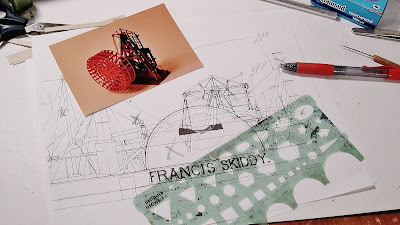
                     Plan modifications revised in red ink for those highlighted areas concerning the
                     hogframes, smokestacks and trusses. Also modified were boilers from photos I
                     used relative to the Kingston steamboat THOMAS CORNELL.


.

                            Close-up view featuring opened sliding door (starboard) at saloon cabin
                            with rigged lifeboat...Inside, I made custom patterned carpeting to simulate
                            a detail commonly featured on these vessels during those times.

Much talk traveled on the river from New York City to Albany, New York during the 1840s about a massive steamboat that would soon join the fleet of heralded steamers operating on the Hudson. Many businessmen, and mariner alike, were contemplating this vessel. It would be the first of its kind anywhere.

At the shipyard of George Collyer in New York City, the keel was laid in 1850 for the large dayboat. The following year, under the scrutiny of draftsmen, businessmen and investors, the wood hull and superstructure began to take form...FRANCIS SKIDDY was now becoming a reality.


                        In this photo the author carefully inspects the detail about the paddlebox
                        which include the miniature mural painting of the Hudson Highlands.


FRANCIS SKIDDY began trips in June of 1852. She was a steamboat of meticulous design and grandeur -the largest and finest vessel of the period. By all standards she was considered the zenith of steamboat architecture and the first four-stacker to make such an appearance. Her cabins were spacious -being finished in polished mahogany for which steamboats of this era was noted. The main cabin was in the hull, extending the entire length; and dining tables were made to seat 500 people.

Aside from these accommodations, FRANCIS SKIDDY was a dayboat which meant speed was a dire factor for her success. She made good on her performance between New York City and Albany by arriving at six landings on the 146 mile route in a record 7 1/2 hours. Her travel started from New York in the morning to Albany -returning back to the city at night.


                   Starboard deck overview show completion of hogframe, tierod and smokestack
                   piping systems...Also on this deck between the paddleboxes, a small portion
                   of the roof is left unpainted. This area will house the A frame that will
                   support the walking beam engine and its various pistons and crankshaft.
                 

                      The author's detailed replica of the FRANCIS SKIDDY walking beam
                       engine based on the plans provided by the late Everett C. Britz. He was a
                       New York businessman and avid collector of steamboat memorabilia. The
                       plans for this engine were drafted by the students of Rensselaer Polytechnic
                       Institute when the SKIDDY was docked at Troy, New York as a nightboat.
                       Mr. Britz served on R.P.I.'s college board during the 1980s and remained
                       a serious collector of my models; one, being this piece he commissioned
                       in 1987.


Those who witnessed this awesome steamboat, whether shoreline or in river passing attested the fact that she was very spacious and a fine craft in artistry. Her performance was first rate as a large vessel. She was wide and long. Her length was 322 feet and she carried a hull beam of 38 feet. Her depth of hold was 10 feet and 4 inches while her water draft was listed as 5 feet 6 inches.The large vertical beam engine she housed was built by James Cunningham and Co. Her four impressive boilers and 40 foot paddlewheels which carried 24 buckets to each wheel were built by John F. Rodman out of New York City.

For a period of three years FRANCIS SKIDDY operated as a dayboat, being celebrated by artists and writers, alike. She was a favorite to the general public. However, her career was short-lived, as she was removed from service and greatly altered to become a nightboat. Instead of Albany being her upstate port, she was docked further north at Troy, running at different periods with the steamboats COMMODORE, HENDRICK HUDSON, RIP VAN WINKLE and C. VANDERBILT.

On the night of November 5, 1864 while travelling southbound, she ran ashore at Staatsburgh and sunk. The hull was later broken up and the engine was placed in the new steamboat DEAN RICHMOND which docked at Albany.

Here, we have a history concerning one of the great steamboats of Hudson River lore, but equally exciting, we now have accurate models that depict how these vessels appeared in their heyday of service. The remaining data of my contribution to this history is not to rewrite what was already written; but rather take the history of these vessels to another area that has rarely been touched. That area are these one of a kind replicas which have rarely been seen in the collectibles market.


                             View of the hurricane deck from port stern as the model progress.


                     Another port view from the stern showing the interesting and symmetrical designs which was typical for many large steamers of the day; especially the tie rod and cable patterns about the hog frames, stacks and masts.     


                                             Closeup detail of the stack, flags and cables...                                           

                               
                       Finding the detail work satisfactory in both construction and finish of the
                       hurricane deck, I proceeded to work on the miniature lifeboats (to scale) 
                       from a solid piece of pine -using my custom templates to assist. Notice the 
                       miniature oars on top of the Kennedy half dollar.


                   My next approach was the pilothouse, but only after inspecting and evaluating
                   the saloon deck details. As with all the superstructure, carving panels around the
                   windows was painstakingly time consuming. Most challenging was to avoid
                   cutting too deep into the wood -as this would cause paint to seep into the crevice
                   and mar the simulated windows.


                                                  Detail close-up of finished pilothouse...


                The next step of the build would now be the walking beam engine which would
                be the final finish to the project -and one which is most tedious due to all the small 
                pieces required to make it. Here, I re-work the plans so that the positioning of the 
                engine is accurate. And since it will be entirely of wood no error can be made.


                     Shown is the work in progress of the A frame and completed engine.                                 


The beginning process showing the finished steam valve system and the early build of the
          cylinder piston rods for the engine.                                                                                         


                                  The A frame takes form...                                                                                                                                                                                                                                                                 
   
                                     Port view close up of finished walking beam engine.                                          


                  Deck view of beam engine from starboard. The complete build of this intricate work 
                       took approximately five days.                                                                                             


Head-on bow view showing the beauty and sleekness of steamboat FRANCIS SKIDDY during her first appearance in 1852. One could only imagine what people saw when she arrived and departed  from those landings.                                                                                                                                                  


                       Another head-on bow view (from starboard) of the FRANCIS SKIDDY.                         


                         Steamboat model FRANCIS SKIDDY c.1852 - port profile overview                            


                         Steamboat model FRANCIS SKIDDY c.1852 - starboard profile overview                  

As I'm about to come to a close, I reflect on how many have supported my work over the years. I have been very fortunate to meet outstanding individuals who have given me the best of their hospitality, friendships, and references. My gift to them (and others) have been to pay it forward by remaining in this genre. Again, I've said it many years ago; and I continue to say it "that we are not islands, but people who need each other for the betterment of one another." So is the case here.

There are a few more images to post, but I must give a thumbs up to Newburgh, New York and the stellar hospitality I have received from the collector who commissioned these works. A thumbs up to those from that area who provided great service to us at their waterfront restaurants. To the law enforcement officer that assisted my personal and professional pursuits via social media; and lastly, to several historians who unselfishly shared their expertise on the city and region relative to it's maritime and citizens. This has been a great 40 year journey... Not just with commissions, but in the projection of knowing we have a Society that still appreciate history -at all levels and all genres, especially the maritime.

Now to close with the remaining images...


         Francis Skiddy painting dated 1859 by noted maritime artist James Bard. 
        Many of my  steamboat models were fashioned around what available paintings 
     were attainable to assist my blueprints. Because of my drafting skills (which I 
      developed as a teenager), former curators and antique dealers considered 
      such plans to be the most accurate and the best in New York State.                                                    

                       Port profile based on the above image of the 1859  Bard painting.                                     


                      Starboard profile (in reverse) based on the James Bard painting.                                      


A view looking south through the northern gateway of the Hudson Highlands from the waterfront pier at Newburgh, New York. The pier which runs along the revitalized commercial area of the city, has a unique array of restaurants that host fine food and people. It bustles year round -as this photo was taken by our daughter, Rexavia, during a brisk late morning in January. We were there to deliver the steamboat model to the Collector.

The Hudson Highlands is the feature painted on the paddleboxes of famed steamboat FRANCIS SKIDDY. This location of waterfront accommodated the citizens with both ferry and steamboat service of which the SKIDDY was one of them.


                   Window view from the Collector's home showing the town and hills of Beacon,  
                New York. With the beautiful steamboat paintings he has to accent the models, this 
                view is honorable.                                                                                                                      


                          Library Parlor... 

Here, in between the sitting area are featured two prolific steamboats I built while residing in New England. On the east bookcase sits the renowned steamboat ALBANY as she appeared when first built; and on the west case the MARY POWELL is featured -also in her original livery... Throughout his home, these thoroughly researched (and carefully planned) models accent areas where the visitor will follow the history of Hudson River steamboating from its early years to its final closure with ALEXANDER HAMILTON. 


                                          Midship view details from starboard...                                                              


With each commissioned model, I'm always asked to provide a custom case. Usually, my cases are made with simplicity. The case should never be so attractive that it 'fights' with the model. The case is there to protect it and keep the model as the 'showcase'...As a result of this principle, my clients have chosen to work with me -and their colleagues work with me because they view the model and lose themselves in the details...as it should be.


When custom making my cases, I also produce my own stains...something I learned while exhibiting in the antique venues at Brimfield, MA years ago. My work is contemporary, but much of it carry the 'antique' flair which accent a unique blend of presentation which is "traditional -contemporary". My models fit into this category, along with my sculptures. Also, many of my past work carry handscripted  wooden plaques as shown in this image.                                                                             


This concludes the blog on FRANCIS SKIDDY. I appreciate my viewers and look forward to presenting more subject matter on those prolific steamboats that ran on our Hudson River. Again, I relish the fact that I can still produce them in my maturity...thanking all of you for being part of the legacy. 

Commissioned work can be honored for any and all Hudson River steamboats. These are fine, one of a kind models that accurately define the vessel as it appeared at any given time of its career. For information please email Caseships@yahoo.com or call 1-774-757-7137 for details.

To view my work and credentials please visit https://youtube.com/c/RexStewartoriginals 

Thank you for viewing!


Sunday, July 26, 2015

Corporate Steamboat Models Today - Rex Stewart


Lobby of Executive Park Towers, Stuyvesant Plaza...author's model of Hudson River steamboat PETER STUYVESANT.

                                                                    
It's not surprising that a resurgence has occurred in office settings that overlook the shorelines on the Eastern seaboard and, across the Atlantic. Whether it be on coastal/ inland rivers, or the ocean, business executives are taking a 'second look' at the maritime -utilizing ship models as part of their interior design.

Steamboats has since been a unique appeal for art and antique collectors since the early '80s when ship models made its debut in maritime galleries throughout the U.S. These beautiful detailed replicas represent a legacy of vessels that is, and was, the core of America's once-booming Industrial Age that came into its own as businesses and communities flourished on coastal shores. Such vessels were the mainstream of contemporary transportation in the 19th century, replacing the sailing ship as designers worked their skill to improve comfort and speed.                                                                                                                                                                                                                                                                                                                                                     

Author's scratch-built model of MARY POWELL at the lower right corner displayed in the President's Room at Albany International circa 1980.


                                                                                                                                                            Since 1980, I learned firsthand through interacting with these collectors, that many of the 'corporate models' requested came as a result of sentiment. Many remembered the historical attributes these   vessels brought to their port-of-call, region, populace and commerce. In New York, the late Governor Mario Cuomo had such a model grace the Mansion's interior as part of its decor. The special model designated for that honor was the steamboat MARY POWELL.

The featured photo in this blog represent the Hudson River steamboat PETER STUYVESANT. It was selected as part of a multi-million dollar renovation project which began in January 2013 at the Executive Park Towers in Stuyvesant Plaza and finished this past January 2015. Prior to that time other corporations featured similar models I built for their offices and boardrooms -starting with Albany International in 1980.


                  Author presenting model of DANIEL DREW to Bank Of America boardroom
                  (formerly Fleet Bank) circa 1988.

The interest for these models continue to be strong -especially for those of 19th/ early 20th century vintage that the Hudson River Valley between New York City and Albany, New York. It was a vision that began 35 years ago with the support of historians, collectors, business leaders, curators and, most importantly -community spirit. We, in part, have a great maritime, and the 'corporate steamboat model' personifies the richness of its history in scale and beauty.


Author's scratch-built model of Hudson River Day Line steamboat ALEXANDER HAMILTON shown  as she appeared circa 1959. This is one of the current corporate requests since her last trip to Bear Mountain circa 1971.


A special note:

The image below is a limited edition (Remarque) print that I offer to celebrate the ALEXANDER HAMILTON. For more information concerning this print email: Caseships@yahoo.com or call 1-774-757-7137.


Concerning commissioned work, I specialize in all Hudson River steamboats (any scale). These are fine one of a kind models that accurately define the vessel as it appeared on the river at any given time of its career.

To view my work and credentials, please visit https://youtube.com/c/RexStewartoriginals and https://www.linkedin.com/in/rexstewart .

Thank you for viewing!

Sunday, April 27, 2014

Cayuga Lake Steamboat FRONTENAC -The Model, Rex Stewart


        Profile plan drawing of Cayuga Lake steamboat FRONTENAC as she appeared in 1878.
        Research and drawing by author Rex Stewart.

Simplicity and lines...Lines and simplicity. All the makings of research and design which finally conclude the making of a prolific steamboat model. FRONTENAC had become an inspirational project for research and build as I explored the sidewheel types that operated beyond the Hudson Valley.

As I investigated this vessel, it was apparent that she was a steamer of note. And yet, as such, I pondered my thoughts as to why no model existed. New York had its great fleet of steamboats beyond the Hudson River. To the north, in and around the Adirondacks, walking beam and inclined engined vessels operated on Lake George and Lake Champlain. To the west and northwest of the State, such graced the mighty Saint Lawrence River and the scenic Finger Lakes. They were beautiful, simple in design, and carried a legacy that became notable...even in tragedy. Such a vessel  of note was the steamer FRONTENAC.

     
               Scene depicts steamer FRONTENAC about to make a commuter run on Cayuga
               Lake late 19th century.

The Industrial Age was the beginning of many inventions large and small in the American culture. It was an era that helped grow and expand the Country toward the 20th century with machine innovation. Steamboats were part of the travel innovation, replacing horse and buggy before the advent of the train and automobile. In the summer of 1820, passengers scheduled to ride stagecoach from Ithaca to Geneva, opted to board a steamboat for the lake's first voyage on the paddlewheeler ENTERPRISE. Fifty years later FRONTENAC became the popular boat.

FRONTENAC was built in 1870 bt T.D. Wilcox of Ithaca, New York at a cost of $50,000. She was a walking-beam sidewheeler with dimensions of 135 feet on the keel and had a hull beam of 22 feet. Her commuter capacity was 350 passengers.

Four years after the passing of T.D. Wilcox, his family heirs sold the business interest to the Cayuga Lake Transportation Company. In 1902, the steamboat and company was sold to Captain Melvin T. Brown of Syracuse. He, inturn, rebuilt parts of the superstructure and replaced the engine with new boilers five years later. It was at that time FRONTENAC encountered her fate after successfully servicing the lake in her 30 year span.

            
              Model detail showing starboard midship view of FRONTENAC. Colorscheme based
              on the 19th century maritime paintings of Antonio Jacobsen and the Bard Brothers.

On the morning of July 27th, 1907 FRONTENAC raced south to meet the northbound MOHAWK to exchange passengers that would have originally went southbound on MOHAWK. After the exchange the sidewheeler returned back north with her 60 passengers, most being women and children. While heading toward Union Springs, rough waters and gale-like winds prevented the steamer to land at both docks in Aurora and Levanna which were located at the widest part of the lake.

Onboard the vessel certain family members noticed smoke coming from the Captain's pilot house and alerted others onboard. On shore many witnessed the steamer catching fire and men from the shore raced out to rescue the passengers and crew. Captain Brown's quick thinking brought the boat near Farley's Point to beach on a sandbar called Dill's Cove.


                                                Port stern profile of steamer Frontenac         

Heavy waves made it difficult for the men to rescue all. In the final event, seven were loss. The incident spread throughout New York and new laws and regulations were passed. As for steamboat travel on Cayuga Lake, the tragedy brought many to move away from it and the business declined with FRONTENAC never being rebuilt. But in the end, many had fond memories of this prolific steamboat and I'm fortunate to have researched and build the first accurate model of this legend.


                   Finger Lakes steamboat FRONTENAC the completed model, built at 1/8 scale.

This was a good build and a very attractive model of note. The time of this build was a month. This and other period steamboat models can be researched and commissioned by contacting Caseships@yahoo.com or calling 1-774-757-7137. More information can be obtained by visiting http://www.artfixdaily.com/blogs/index/Steamboat_Models_-The_Rare_Investment and https://www.linkedin.com/in/rexstewart


Thursday, December 8, 2011

Steamboat Model MARY POWELL c.1887 -The History and Build/ Rex Stewart

Few models exist on the renowned sidewheeler MARY POWELL. Some have been produced with minute detail while others varied in levels of craftsmanship and quality. But no matter how the steamboat has been presented over the years, MARY POWELL remain to be, nationally and internationally, one of the most favorite builder subjects today.

MARY POWELL was built at the onset of the Civil War. She was launched in 1861 at the request of Captain Absalom Anderson who, prior to the "M.P.", commanded the THOMAS POWELL -a swift sidewheeler known to many as the "Swan of the Hudson."


                Steamer MARY POWELL docked at Rondout Creek, New York c.1887


Thomas Powell was a prominent citizen of the village of Newburgh, NY located 60 miles north of New York City on the west bank of the Hudson River. The firm of T. Powell and Company composed of Powell and Captains Samuel Johnson and Robert Wardrop who established a steamboat line in 1835 which lasted ten years. Upon dissolving the line, Powell kept the steamboat HIGHLANDER and went into partnership with his son-in-law, Homer Ramsdell.
In 1846, Powell and Ramsdell brought out the new THOMAS POWELL for day service between Newburgh and New York City. She ran in line with HIGHLANDER and two years later, because of fierce competition, Powell and Ramsdell sold their interests to the Anderson and Romer families. As steamboats were being acquired by different firms along the Hudson, there was a need for fast and reliable boats. A new steamboat came to the river in 1860 named the DANIEL DREW, a celebrated New York-Albany dayboat that gained reputation on the Hudson when she raced and beat the ARMENIA of river fame.

Captain Anderson, viewing the swift DANIEL DREW as she daily passed his Rondout dock, knew that it was time to upgrade and build a new steamboat that would be the talk of the entire Hudson Valley for next six decades. The sidewheeler would be the inevitable "Queen of the Hudson". The name being the MARY POWELL. Anderson's goal was to have a vessel that would outdo every Hudson River steamboat known. He made it clear to the builders that the vessel had to make better time than his THOMAS POWELL -and that a heavy forfeiture of the contract would be in place if that recommendation failed. When the Allison Shipyard in Jersey City, N.J. completed MARY POWELL, she measured 267 feet in length, with a beam of 34.5 feet and depth of hold at 9.2 feet. Her tonnage was 819.
Because of Captain Anderson's steamboat ties in the area, and his highest respect for Thomas Powell, it was only fitting to name his vessel after Powell's wife whom, in her own right, had ties of historical proportions in the maritime.

Mary Ludlow Powell established a firm maritime history in addition to being the widow of Thomas Powell. Her eldest brother entered the United States Navy as a midshipman in 1795 and rose to the rank of captain. Mary's next eldest, Robert Ludlow, had been assigned to the U.S.F. CONSTITUTION and was aboard when "Old Ironsides" encountered and captured  H.M.S. JAVA in December, 1812. The best-known brother, Augustus C. Ludlow, was James Lawrence's first lieutenant on the CHESAPEAKE in the engagement with H.M.S. SHANNON off Boston on June 1, 1813. It was in this battle that the mortally wounded Lawrence gave the vain command, "Don't give up the ship!"


      War of 1812 CONSTITUTION Battle Station, handcarved in wood by the author. This
      representation show how the men were positioned during the fight with HMS JAVA
      when Mary Ludlow's brother served...Hand-carved action onboard CONSTITUTION
      can be seen in this video

                                 https://www.youtube.com/watch?v=wv0_HC0cwrM

The MARY POWELL, now on the waters of the Hudson, was now becoming the echo of river folklore. In 1867, Captain Anderson retired from the steamboat business after selling his shares of MARY POWELL to Thomas Cornell, the steamboat potentate of Rondout, N.Y. This purchase was made three years prior. For several years, as the steamboat changed ownership, it was being scrutinized for performance. Then in 1874, a young steward came aboard the vessel, the young son of retired Captain Absalom Anderson. His name was Absalom Eltinge Anderson who would, many years later, become the prolific captain of the renowned steamer.

In 1872 the MARY POWELL returned back to Captain Anderson and remained with the family until 1883 when Thomas Cornell, again, acquired her. When the successor, Jansen Anderson, the Captain's eldest son passed away, Eltinge was not looked upon as the possible choice to keep the legacy of the family business. Between the seasons of 1884 and 1885 Eltinge, determined to prove otherwise, devoted much of his time preparing a pamphlet to promote the MARY POWELL. As a result of his efforts, Captain William Cornell retired and sold his share in the vessel to Eltinge.


           Portrait of the young Captain Absalom Eltinge Anderson, stmr. MARY POWELL


The MARY POWELL became the heart of steamboat folklore. For 55 years she travelled the Hudson and entered practically every port on her route. She was both beautiful and fast, having surpassed records of her contemporaries with no loss of life. She transported dignitaries and royals and accommodated renowned men and women of her day. She was a favorite at West Point and all points south of that landing. North, she was respected and won the hearts of the Albany-Troy citizens and was embraced as "The Queen" of riverboats.

In 1920 she finally ceased operations on the Hudson River and became legendary years afterward. A book about her was written by my friend and author, Donald C. Ringwald, and several years later, a descendant of the Mary Powell Family, Pauline Hending Matherson, commissioned me to build her an exacting model of the steamboat -which is in their Vermont home today.


             Bard painting of MARY POWELL as she first appeared on the river c.1861

Several MARY POWELL models were built in Albany during the '80s and early '90s -and a new version is now being built in New England at my Southbridge, MA studio. This version is the famous steamboat as she first appeared on the river in 1861 and is probably the only one of its kind anywhere, to date. This will be shared with the public and maritime community in a few months. To conclude, below are images of MARY POWELL as she appeared in 1887.


      Constructed entirely of wood, this project took approximately two months to build and
      is considered one of the most accurate models in the Hudson River Valley.


    This closeup shows the meticulous superstructure of MARY POWELL, from walking
    beam engine down to her paddlewheels. Her racy hogframes were state-of-the-art; a
    beautiful, graceful design that no other steamboat of her class carried. This was, in
    essence, MARY POWELL the "Queen of the Hudson".     


Social Share Toolbar