Showing posts with label steamboatmodels. Show all posts

Thursday, July 16, 2020

Modelling HENDRICK HUDSON -Newburgh's Own...Part Two /Rex Stewart


Starboard overview of the much-heralded HENDRICK HUDSON as a scratchbuilt model.

It's been a year since the build of this historically accurate model which found it's home in its birth-city of Newburgh, New York. As I reflect, I think of the first model request I encountered some 33 years ago by one of the owner's family members, Alfred Van Olcott.

When he visited my artist studio that spring of 1987, he brought along with him the detailed blueprints of HENDRICK HUDSON. Al stated that he heard about my legendary echo up and down the Hudson Valley as being the only artist-craftsman that built accurate models of the Hudson River steamboats -both vintage and contemporary. He fixed his eyes on the ALEXANDER HAMILTON that was destined to a Scotia resident with another (in progress of the ROBERT FULTON).

Both models were a visual testament that convinced Olcott to commission. But what I found most interesting was his dissatisfaction of the family model that was exhibited at the Smithsonian in Washington, D.C. He stated that my work superceded the HENDRICK HUDSON showcased  there and that he was honored to have come to Albany, New York to meet me. But, in reverse, I was honored to meet the former heir of the famous Hudson River Day Line.

So the saga began with him, a notable steamboat owner who passed the baton to me in an effort to honor a resident collector in the city where the famed HENDRICK HUDSON was built, Newburgh, New York.

In my last blog I left off building the main deck. In this blog, I cover the remaining build of the saloon, promenade and hurricane decks prior to finishing.

Below, with main decks, cabin and rail systems in place, I now advance to the next level working on  saloon deck sections. I realize that blueprints give detail, but seldom are accurate...So, to get the work  close to the actual appearance, much photo data is needed. However, I've built models based on just one or two photos.                     


As the build continue, I work up to the promenade deck -satisfied that the saloon and parlors are perfectly aligned as shown in the next images...


Stern starboard view of the finished saloon -minus the outboard seating, which will be added before enclosing the deck.

Being a historian has its advantages in the world of fine art...and craftsmanship. It's not enough to produce a fine piece, but rather make it as authentic as possible based on established history. It is never wise to label a thing 'authentic' if it can't be proven or backed with evidence. True collectors know that the research I place in the work is flawless...and some have amassed a series of models from my table as a result. 

The HENDRICK HUDSON was the first largest steamboat to enter service on the river in 1907. She was built to celebrate the 300th anniversary of its namesake explorer who discovered New York's scenic river in 1609. Below, two supporting images show the launching of HENDRICK HUDSON at the T. S. Marvel Shipyard at Newburgh, New York.


The HENDRICK HUDSON is launched down the ways into the Hudson River, March 31, 1906 in view of  5,000 onlookers, shipyard attendees, and city officials. Below, the elegant and popular HENDRICK HUDSON backs around the "knuckle" of the Albany Yacht Club pier and into her berth after returning from a downriver excursion August 21, 1940.


The subject matter of these beautiful vessels is, nevertheless a hallmark for any builder who desires to pursue them. I was very fortunate to climb aboard into an era that would eventually fade away during the decade of the 1990s. Taking advantage of the opportunity, I worked diligently (and closely) with anyone who had first hand knowledge of these steamboats...But then again, I didn't have to go very far, because this special network came to me, re: family members (heirs) of those steamboats, curators, collectors, museum personnel, authors and even the passenger alumni themselves.

However, the key to it all were the business leaders, lawyers and judges, politicians, and private citizens who contributed and guided my research based on the integrity of trust. They all knew I would produce some of the most accurate pieces (without bias) in the Hudson Valley -and beyond. For that, I knew this was one of my purposes as an artist-craftsman relative to documenting the river's transportation legacy in the form of model steamboats.

Continuing with the build, I now work on the promenade deck with both excitement and anticipation. The supporting images show how awesome the designers were in those times. Their expertise in symmetric design not only made HENDRICK HUDSON a sleek looking vessel, but her interior elegance was second to none. 


This port profile view show the progress made on the promenade deck of HENDRICK HUDSON. The total build time for this deck area was two and a half weeks.


Upon completing the promenade, I carefully aligned the hurricane deck -making sure the stacks, pilothouse and skylights were properly aligned...using for reference the original deck plan(s) and vintage photo (shown below). The hole that is seen on the hurricane I cut the hole seen on the hurricane above the sliding doors of the observation cabin. The effect that I wanted was to have light penetrate  the windows of the roof dome to illuminate the interior cabin and stairwell. This can also be seen in the second photo which highlight the stairwell which was known as "Stairway of the Dragon".

 
Vintage photo that assisted with the HENDRICK HUDSON build. This photo was one of many given to me by Herman Boyle of Kingston, New York during my several Saturday visits to his home on Washington Street. He was a riverman that worked on the tugs, but had a large collection of vintage photos depicting steamboat life on the Hudson River.


Interior view of the observation parlor showing the skylight dome over the stairwell leading down to the saloon cabin. In the view looking forward is a mural of the Dutch VOC sailing ship Half Moon. The HENDRICK HUDSON, in all her breathtaking elegance, not only had this feature mural, but  others of note in various locations.These commissioned pieces were Washington Irving's home, the Senate House at Kingston, and the Capitol at Albany, New York.

Moving along in the build (shown below), I discovered additional details which I applied to the model that was absent from the early Olcott commission. And though that model was featured in a televised PBS documentary, this HENDRICK HUDSON would break ground to be one of the best ever produced.

Below are work in progress photos of the promenade and shade decks...


Here, I attach flags prior to finishing. This is usually done to avoid premature damage to the model while addressing delicate details. Furthermore this procedure forces me to concentrate on the total build while working in segments. Elegance, even in miniature comes with a price -which is time, effort and patience.

The HENDRICK HUDSON was indeed elegant, and wasn't rushed into service as some historians have stated. Her true test came the following year in 1907, not 1906 as some have documented. Even the heir of the family business told me her true service began during the 1907 season..Only a trail run occurred in August of that year. A partial schedule (below) confirms her official 1907 service year..


When Ellis Island was established in 1892, immigrants from around the world came to America for opportunity and a better life. Through the period between 1892 and 1901 many immigrants remained in New York City, but some ventured west and south to apply their trade and skills. It was the Industrial Age and practically everyone had a vision to prosper. 

Working in the shipyards and coastal cities along the Hudson River presented those opportunities and steamboating became a business that generated income for any culture willing to endorse it. As a result, when the Hudson River Day Line welcomed these cultures, it gave them honor by celebrating their contributions in the Hudson Valley by flying international flags on its fleet. Below are three port and starboard views showing these flags which were occasionally rotated.


The first set of flags represent The Netherlands and France. The second set are the countries of  Canada and Norway. The third, flags of Italy and Denmark. Finally, on the back staffs (not visible) are the flags of Japan and Puerto Rico.

As a collectible and investment, I produce these models with as much accuracy as possible and integrate them with history by way of these blogs. It's who I am as an artist, craftsman, visionary and historian. Research is not centered on biases, but rather on evidence that support the quality of workmanship I was given to do. So to that end, I close this portion of "Modelling HENDRICK HUDSON -Newburgh's Own"...with anticipation of soon presenting the finale.

For those who would like to own one of these prolific models -or any notable Hudson River steamboat, I can be contacted at Caseships@yahoo.com...or, at 774-757-7137 for details. My credentials can be found at  https://www.linkedin.com/in/rexstewart and https://youtube.com/c/RexStewartoriginals.

Thank you for viewing!


Monday, July 29, 2019

Modelling HENDRICK HUDSON -Newburgh's Own...Part One


Steamboat modelmaking has been one of my professional niches for well over forty years. Many of these gems have graced the homes of collectors, galleries, museums, and corporate offices throughout America and abroad. But what make this particular model so special is that the namesake celebrate the Hudson River where HENDRICK HUDSON operated -and the fact that Henry Hudson sailed the Dutch ship HALF MOON up this scenic river in 1609.

I had the honor of meeting a Newburgh native who amassed a beautiful collection of steamboats which became quite prolific as he carefully selected projects representing the gradual development of steamboat construction from the early 1830s to the 1970s -with all models accurately researched and built to 3/32 scale.

To this end HENDRICK HUDSON became the 100th steamboat model built during my forty year tenure.


        The plans shown here were enlarged from a previous build which was at a smaller scale. That particular project was for the former heir of the Hudson River Day Line -basing the model on the vessel's 1940 configuration. This build will feature the steamer as she appeared on the river in 1909.


          The beautiful and spacious HENDRICK HUDSON departs the Capitol City of Albany, New York enroute to all ports of call before ending her eight hour run at New York City c.1912.


After reviewing all the data, with the support of the Collector's references, I started putting into place the schematics for a more updated and accurate build...beginning with the hull and decks. The hull would be hand-chiseled out of select yellow pine and the decks shaped from basswood sheets.


                                             Here, I carefully chisel and shape the stern...


                       After chiseling and shaping, sanding is performed and the keel is attached.


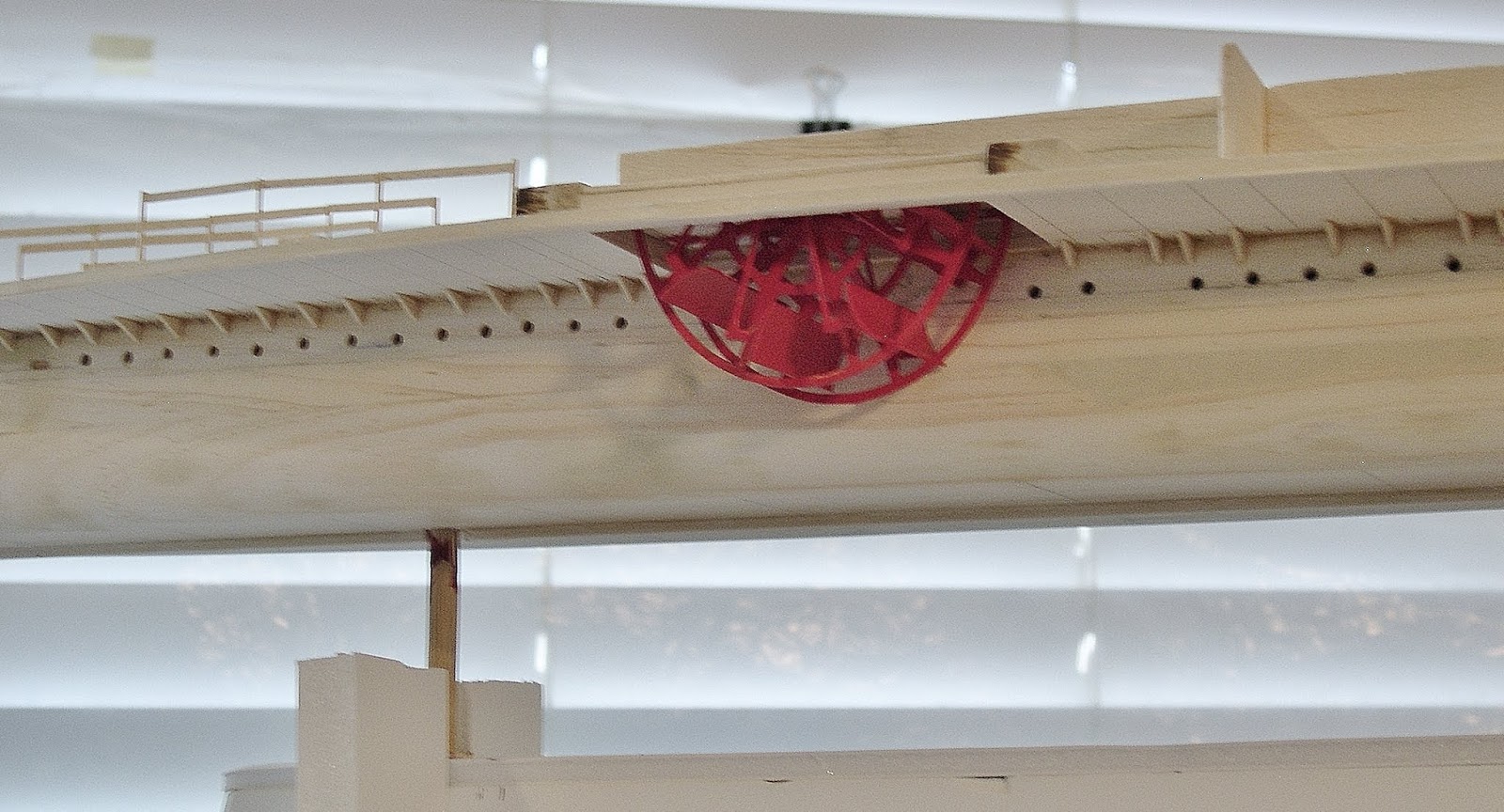
Paddlewheels are usually the second feature addressed on these steamboats, due to the fact that errors can occur within spacing between hull and main deck guards. These feathering wheels are made solely of basswood.


The third feature of the build are the stacks which determine the height of each deck in proportion to the vessel's length. This procedure has given accurate models...even if scales are miscalculated.  From here, I move on to the knees and strakes beneath the main deck -making sure every piece of wood is  aligned properly. If off by 1/16 inch the entire project is ruined and can't be corrected.

The next two images show the knee and strake system...


 The next step of the build is planning the deck layout. Two different versions were made, so careful   attention had to be centered on the doors and cabin arrangements. Changes were made in these areas   and proper alignment of these features will guarantee proper spacing of windows and rails   throughout the entire build. The plans are not absolute (which I learned years ago when pursuing the   first HENDRICK HUDSON model). It was by far the best model ever made, but there were flaws   based on the architectural drawings of those times.

With the fleet of steamboat models to my credit, I wanted to make sure this 100th model was my very best.


            After mapping out the interior main deck with balsa compartments, the bass cabins are next to be addressed -followed by the chock, kevel, cleat and rail systems. This now present the build for the entire model.

As I worked on the model for several weeks, I paid much attention to HENDRICK HUDSON's superstructure and the international flags that graced her staffs over the hurricane deck. I and the Collector discussed this in length -and basically used the references he provided, along with the notes of Mr.Van Olcott (formerly of Princeton, New Jersey) and Herman Boyle (formerly of Kingston, New York). Both were knowledgeable concerning the Day Line and both had references that helped get the accuracy of the flags in correct order.

From photos, only ten cultures were celebrated in the Hudson Valley; but the vessel only carried eight staffs -so the two remaining flags were probably rotated at different occasions. However, the legacy of the Hudson River Day Line was that it supported all peoples of the valley, regardless of heritage.


Photo of HENDRICK HUDSON steaming past Coxsackie flying the international flags circa 1912. This was printed from a glass plate by Herman Boyle c.1983


                                 Another view of the balsa compartments...


This photo image show the compartments supporting the main deck cabin area and stanchions. Everything is perfectly aligned as a result. This partial view of cabin work took approximately five full days to finish.


So not to mar the hull that has been painted and treated, I hold tissue between it and my hand while carefully cutting away excess paper that enclose the cabin acetate windows. The paper covering is layered for each deck so that the windows are shown to perfection without dust or debris. Since sliding doors are usually open, these are lightly taped while I finish the cabin(s)...The tape is removed after the deck is completed -working this process with each deck application.


Stern main deck cabins being painted while the paper covering is turned back for adding the acetate windows. The balsa compartments and inner stanchions are painted a deep grey so to obstruct any viewing of adhesion around the windows. Sliding doors are then placed, followed by cabin painting  to also divert attention to the interior windows. Finally the paper covering is glued to the cabins for easier placement of the saloon deck.


 Port profile showing the sleek and graceful lines of Day Line steamer HENDRICK HUDSON. This work in progress photo salute all the writings concerning this vessel. She was, in fact, beautiful and was a luxury to river travel at a cost of nearly one million dollars at the time of her build. She had an advertised length of over 400 feet and was licensed to carry 5,500 passengers.

Art was commissioned for interior decoration. Murals depicting Henry Hudson's HALF MOON, Washington Irving's home, the Senate House at Kingston, and the Capitol at Albany were part of the interior displays. She was, in fact, New York's finest Dayliner.


This port bow view shows the steady progress of construction. There is much more to reveal in Part Two of this build; that along with exceptional detail to follow. All my models (past and present) are uniquely one of a kind. They are worth viewing ; if not for the beauty then for the detail.

The Hudson Valley has many hidden gems, especially the steamboat models which is available to any discerning collector.

Commissioned work can be honored for any and all Hudson River steamboats. These are fine, one of a kind models that accurately define the vessel as it appeared at any given time of its career. For contact please email: Caseships@yahoo.com or call 1-774-757-7137 for details. To view my work and credentials please visit https://www.linkedin.com/in/rexstewart and https://youtube.com/c/RexStewartoriginals

Thank you for viewing!


Thursday, November 3, 2011

A Rare Model Steamboat -JACOB H. TREMPER c.1886


       Freight steamer JACOB H. TREMPER in Rondout Creek -Kingston, New York c.1886


The JACOB H. TREMPER was a popular sidewheeler that operated on the Hudson River during the late 19th and early 20th century. When reading articles, including those written by friend and author Donald C. Ringwald, I became curious why little was mentioned about this particular steamboat.

Three years passed since reading about the TREMPER, and by chance I discovered photos of this vessel in the archives of the Albany Institute of History and Art. The photo showed the steamer docked at Albany's pier in the early 1900s. The following year another photo surfaced from a bookstore across the river in Troy, New York -and, several months later more photos were found which now escalated my curiosity.

As data began to build, I learned that an elder riverman whom lived downriver had an extensive Collection on steamboat memorabilia -including vintage glass plates on river activity. At the urging of supporters I went to visit this gentlemen at his home in Kingston, New York. After viewing this outstanding material, Mr. Herman Boyle and I came upon many highly detailed and interesting photos of JACOB H. TREMPER.

Mr. Boyle told me how popular and valuable the vessel was to the river and the region. He then presented me a copy of George Murdocks' 1939 article.  After reading, I set out to research all the photos I acquired and then set to motion the preliminary sketches for the deck layout of this steamboat. Because of this vessel's unique design, several attempts were made to space the windows accurately to be insync with the hogframes and cabin configurations.

There were times when I had to step away from the area to get my bearings in order to re-work the plans. I now knew what it was like to be a draftsman and incorporate countless hours in a specific detail. One flaw, in scale, could ruin an entire project. What made this assignment special was, no models existed on this popular steamboat. It was to be the only accurate and rare model in the entire Hudson Valley.


          JACOB H. TREMPER Sectional Profile Plan -researched and drawn by author


The JACOB H. TREMPER was built in 1885 by Herbert Lawrence at Greenpoint, New York -the place where my father lived out his years. Her engine was constructed by W.A. Fletcher Company of New York. She was 180 feet long with a beam breadth of 30 feet. Her gross tonnage was 572. She carried a vertical beam engine which had a cyclinder diameter of 44 inches with a ten foot stroke.

TREMPER was built for the firm of Romer and Tremper of Rondout to be used as both freight and passenger steamboat. The service would be between the cities of Newburgh and Albany. The steamer was to run in line with the M. MARTIN, replacing EAGLE which was destroyed by fire two years prior.


         JACOB H. TREMPER passing Knickerbocker Dock on the Lower Hudson c.1906


The new steamboat proved to be a fine and exceptional vessel for the purpose forwhich she was built. She had a large freight capacity and fine accommodations for passengers -and these ammenities soon made themselves evident by the TREMPER being first to appear on the river in the spring of the year and the last to be laid up in the fall.

Romer and Tremper sold their fleet of steamboats in 1899 to the Central Hudson Steamboat Company in Newburgh. Serving this company, she had only one accident. This occurred on Monday morning, July 21, 1913. On that morning, JACOB H. TREMPER left Newburgh for Albany. As she steamed north she struck an unchartered rock off Esopus Island. The captain quickly ordered her course for the mud flats off Staatsburg on the east side of the river where she sanked. She was eventually raised, repaired and began her regular run in 1916 under the command of Captain John Dearstyne.

The JACOB H. TREMPER was one of the last sidewheel steamboats of her class to continue in service on the waters of the Hudson River. In the Fall of 1928 the vessel was deemed unfit and laid up at Newburgh. The following year she was sold and broken up by a dealer in the same city.


Scale Model of Hudson River Steamboat JACOB H. TREMPER as she appeared in 1886


 For more information about commissioning a fine quality Hudson River or Northeast steamboat model email:Caseships@yahoo.com or call 1-774-757-7137. You may also visit https://www.linkedin.com/in/rexstewart


Social Share Toolbar

Monday, October 31, 2011

Steamboat HENDRICK HUDSON -Model In Miniature


           Hudson River Day Line stmr. HENDRICK HUDSON traveling downriver toward
          toward Poughkeepsie, New York c.1920.


Many articles and several film footages have honored this handsome steamer since her first appearance on the Hudson River in 1906. As a builder I had the opportunity to meet Alfred Van Olcott, the great-grandson and heir to the Hudson River Day Line.

Mr. Van Olcott saw my exhibition at the Hudson River Maritime Center when I held my first steamboat showing during the early '80s. He spoke about a builder's model that his family donated to the Smithsonian Museum in Washington,D.C. that he wasn't particularly happy with. In his own opinion he thought "it wasn't a great or good looking model". In turn, after several meetings -and viewing his impressive photo collection of HENDRICK HUDSON, he commissioned a model that he wanted to be of "superb quality".

I spent a month reviewing the HUDSON's history and re-worked the plans he loaned and, similiar to former steamboat projects endeavored, there were no available profile drawings. I had to build the sidewheeler from those references I produced on ROBERT FULTON a few years prior. The height between decks were fairly similiar in scale, so I followed the deck layout of Mr. Olcott's materials, along with the supporting photo data to arrive at a model that would be, in laymens' terms -accurate.


          Starboard profile, in detail, of wooden steamboat model HENDRICK HUDSON.
          At 1:160 Scale she's shown as she appeared in 1943, four years before she
          ceased service on the river.

Van Olcott would visit twice from Princeton, N.J. before viewing the final completion. He was elated that his favorite sidewheeler was "captured in her true appearance". He shared this model with many affluent personalities in the maritime, especially those whom were steamboat-connected. As a model HENDRICK HUDSON became the flagship of my fleet of contemporary models, being written about by several authors and featured in a documentary by a television station in Kingston, New York in 1990. Today, the model is part of the Hudson
River Maritime Museum's collective body of steamboats currently exhibited at the facility.

HENDRICK HUDSON was built in 1906 at the T.S. Marvel Shipyard, Newburgh, New York. She was a beautiful steamer throughout at 390 feet and the second largest vessel to operate for the Hudson River Day Line.

In 1935 and 1936, the Day Line achieved great success with its excursion programs. And in 1937 the Line used their largest steamer HENDRICK HUDSON which was to become an annual event. With her 5,252 passenger capacity, HUDSON was larger than either HAMILTON or FULTON. Because of this, the schedule was altered so that the excursion originated at Indian Point which added Catskill as a landing. The departure times from Newburgh, Poughkeepsie and Kingston Point didn't change and the round trip fare remained at a dollar. The departure time from albany on the return trip was advanced to 4:30 p.m.

Also historic in 1937 was the final port to port passing of HENDRICK HUDSON with the largest nightboat on the river, the BERKSHIRE. This happened on a summer night in August
as the Day Liner left Newburgh shortly after 10 p.m. for its final destination upriver to Indian Point. Thirteen nights after that historic river passing the Night Line terminated service.


  Stmr. HENDRICK HUDSON backing out around the knuckle of the Albany Yacht Club
  on a summer afternoon c.1940.


HENDRICK HUDSON serviced many passengers during the War years since gasoline was rationed to automobile owners. Travel by car was limited, but the steamboat business has stellar years. The total number of passengers rose to 1,431,000 -the highest number since 1930. With so many pasengers traveling the Day Line's upriver excursions to Albany ceased and the Line converted to travel only.

HENDRICK HUDSON operated on the Hudson River between New York and Albany until 1948. She was later scrapped in 1951.


                         The wood model of HENDRICK HUDSON c.1943,  1:160 Scale

Mr. Olcott was a great help providing much of the data for this model. So many individuals whom had a love for these vessels are now departed, but their memories are with us and in these models that I faithfully produce in honor of them. And the histories that these vessels made during their tenure on the river is a tribute that can be preserved within these works for years to come.

For more information about commissioning a fine Hudson River or Northeast steamboat model email: Caseships@yahoo.com or call 1-774-757-7137. You may also visit  https://www.linkedin.com/in/rexstewart 


Social Share Toolbar

Friday, October 28, 2011

Collectible and Rare -The Steamboat Model /Rex Stewart

When New York celebrated its Hudson-Fulton Event in 2007, followed by the NY 400 Celebration of HALF MOON and Henry Hudson's namesake river, every museum and society between Albany and New York City had exhibitions.

From paintings, photographs and models, to fundraisers and lectures. Everything  river-related was shown. But what many facilities didn't have to support these venues were steamboat models. I reviewed every exhibition in the Hudson Valley and discovered only a few good models were shown from the hundred or so I produced in my studio.


These events indicated that those who owned these small gems did not want to part with them for public exhibition. Also on the antique circuit while showing at Brimfield, MA many buyers desired the NANTUCKET model and, when it was sold others who returned to the booth commissioned models that were from other regions in the Northeast. This event also brought awareness that steamboat models were very much in demand, especially to the connessiour who knew these were rare collectibles.

Exploring further, at auctions, few of these items surfaced and to my awe I learned that a simple folk art model sold for $15,000. Occasionally a high-quality detailed model would enter an auction floor and be swooped up by a knowledgeable buyer/collector. A few of my models were recently sold highend or slightly below their original value which dispell the myth that these aren't in demand as contemporary works.


                                 Antique folk art model of a Mississippi sidewheeler.

If one look upon today's shipmodel industry, it's apparent that there are less than twenty or so good models promoted as kits. Some are expensive and others are moderately priced. When built, depending on how much detail is involved, can become a highend collectible. Yet understand that these are kits. Beyond the kit types are models of another class, the scratchbuilt and folkart divisions. Folk art pieces are those works that are crude in appearance and simplistic in detail. However, because of rarity, these are highly sought after. Many were produced during the heydey of steamboating by crew members who wanted display pieces to remember the vessel they served on.

The highend collectible that would be most desirable to the serious buyer would be the thoroughly researched scratchbuilt model. These are called 'special class' or 'builder's models -the best of the best.


     A rare 'Rex Stewart' model of the famous Hudson River sidewheeler DANIEL DREW
    in the corporate boardroom of Bank Of America. A rare steamboat print accents the
    model.


The more famous the vessel...the fewer built as models...the higher the price. Many dealers won't disclose this, but it's a fact.

At the Smithsonian Museum in Washington, D.C. there is a Hudson River Day Line model of HENDRICK HUDSON. That model was donated to the Museum by the Olcott family, owners of that Line. However, one of the family heirs commissioned a model from my studio and that model is today exhibited at the Hudson River Maritime Museum in Kingston, New York. Seldom are these models at auction and few are made.

In the past twenty years steamboat models have exceeded expectations at auction venues -and models that represent the Northeast Corridor of the USA are quickly bidded upon and sold. Furthermore, those collectors whom I visited either owned a steamboat print or painting and desired a model to accent those heirlooms which, in essence, became a nice balance.


       A rare contemporary diorama showing the island steamer NANTUCKET carrying
       passengers to the mainland as it passes a bouy and catboat on a summer afternoon
       in 1890. Wood-sculpted collectible produced at the studio of the author.

Because steamboat collecting is a new trend, brought about in the 1960s; this unique category is fast becoming a field to watch.


           A 'Rex Stewart' model that sold in New York City at Bonham Auction in April
           2011 for $5,538.00. A wood model that was considered high-quality and one of
           the few in its category to supercede other bids.

Some thirty years ago, after producing over a hundred models, I encouraged investors to acquire them. Not so much because I produced them, but because miniature gems were part of an era fading into the annals of history and becoming an Americana heirloom.

The American steamboat, as we know it, is no longer. The only remnant to the Northeast steamer are the scale models I faithfully produce. They can't be copied or found anywhere except in Central Massachusetts where they are researched and built with blueprint-precision.

These are the highend models of today...a rare and valuable collectible of yesteryear, the steamboat.

For more information about commissioning a fine quality Hudson River or Northeast steamboat model email: Caseships@yahoo.com or call 1-774-757-7137. You may also visit https://www.linkedin.com/in/rexstewart


Social Share Toolbar