Showing posts with label Newburgh. Show all posts

Thursday, July 16, 2020

Modelling HENDRICK HUDSON -Newburgh's Own...Part Two /Rex Stewart


Starboard overview of the much-heralded HENDRICK HUDSON as a scratchbuilt model.

It's been a year since the build of this historically accurate model which found it's home in its birth-city of Newburgh, New York. As I reflect, I think of the first model request I encountered some 33 years ago by one of the owner's family members, Alfred Van Olcott.

When he visited my artist studio that spring of 1987, he brought along with him the detailed blueprints of HENDRICK HUDSON. Al stated that he heard about my legendary echo up and down the Hudson Valley as being the only artist-craftsman that built accurate models of the Hudson River steamboats -both vintage and contemporary. He fixed his eyes on the ALEXANDER HAMILTON that was destined to a Scotia resident with another (in progress of the ROBERT FULTON).

Both models were a visual testament that convinced Olcott to commission. But what I found most interesting was his dissatisfaction of the family model that was exhibited at the Smithsonian in Washington, D.C. He stated that my work superceded the HENDRICK HUDSON showcased  there and that he was honored to have come to Albany, New York to meet me. But, in reverse, I was honored to meet the former heir of the famous Hudson River Day Line.

So the saga began with him, a notable steamboat owner who passed the baton to me in an effort to honor a resident collector in the city where the famed HENDRICK HUDSON was built, Newburgh, New York.

In my last blog I left off building the main deck. In this blog, I cover the remaining build of the saloon, promenade and hurricane decks prior to finishing.

Below, with main decks, cabin and rail systems in place, I now advance to the next level working on  saloon deck sections. I realize that blueprints give detail, but seldom are accurate...So, to get the work  close to the actual appearance, much photo data is needed. However, I've built models based on just one or two photos.                     


As the build continue, I work up to the promenade deck -satisfied that the saloon and parlors are perfectly aligned as shown in the next images...


Stern starboard view of the finished saloon -minus the outboard seating, which will be added before enclosing the deck.

Being a historian has its advantages in the world of fine art...and craftsmanship. It's not enough to produce a fine piece, but rather make it as authentic as possible based on established history. It is never wise to label a thing 'authentic' if it can't be proven or backed with evidence. True collectors know that the research I place in the work is flawless...and some have amassed a series of models from my table as a result. 

The HENDRICK HUDSON was the first largest steamboat to enter service on the river in 1907. She was built to celebrate the 300th anniversary of its namesake explorer who discovered New York's scenic river in 1609. Below, two supporting images show the launching of HENDRICK HUDSON at the T. S. Marvel Shipyard at Newburgh, New York.


The HENDRICK HUDSON is launched down the ways into the Hudson River, March 31, 1906 in view of  5,000 onlookers, shipyard attendees, and city officials. Below, the elegant and popular HENDRICK HUDSON backs around the "knuckle" of the Albany Yacht Club pier and into her berth after returning from a downriver excursion August 21, 1940.


The subject matter of these beautiful vessels is, nevertheless a hallmark for any builder who desires to pursue them. I was very fortunate to climb aboard into an era that would eventually fade away during the decade of the 1990s. Taking advantage of the opportunity, I worked diligently (and closely) with anyone who had first hand knowledge of these steamboats...But then again, I didn't have to go very far, because this special network came to me, re: family members (heirs) of those steamboats, curators, collectors, museum personnel, authors and even the passenger alumni themselves.

However, the key to it all were the business leaders, lawyers and judges, politicians, and private citizens who contributed and guided my research based on the integrity of trust. They all knew I would produce some of the most accurate pieces (without bias) in the Hudson Valley -and beyond. For that, I knew this was one of my purposes as an artist-craftsman relative to documenting the river's transportation legacy in the form of model steamboats.

Continuing with the build, I now work on the promenade deck with both excitement and anticipation. The supporting images show how awesome the designers were in those times. Their expertise in symmetric design not only made HENDRICK HUDSON a sleek looking vessel, but her interior elegance was second to none. 


This port profile view show the progress made on the promenade deck of HENDRICK HUDSON. The total build time for this deck area was two and a half weeks.


Upon completing the promenade, I carefully aligned the hurricane deck -making sure the stacks, pilothouse and skylights were properly aligned...using for reference the original deck plan(s) and vintage photo (shown below). The hole that is seen on the hurricane I cut the hole seen on the hurricane above the sliding doors of the observation cabin. The effect that I wanted was to have light penetrate  the windows of the roof dome to illuminate the interior cabin and stairwell. This can also be seen in the second photo which highlight the stairwell which was known as "Stairway of the Dragon".

 
Vintage photo that assisted with the HENDRICK HUDSON build. This photo was one of many given to me by Herman Boyle of Kingston, New York during my several Saturday visits to his home on Washington Street. He was a riverman that worked on the tugs, but had a large collection of vintage photos depicting steamboat life on the Hudson River.


Interior view of the observation parlor showing the skylight dome over the stairwell leading down to the saloon cabin. In the view looking forward is a mural of the Dutch VOC sailing ship Half Moon. The HENDRICK HUDSON, in all her breathtaking elegance, not only had this feature mural, but  others of note in various locations.These commissioned pieces were Washington Irving's home, the Senate House at Kingston, and the Capitol at Albany, New York.

Moving along in the build (shown below), I discovered additional details which I applied to the model that was absent from the early Olcott commission. And though that model was featured in a televised PBS documentary, this HENDRICK HUDSON would break ground to be one of the best ever produced.

Below are work in progress photos of the promenade and shade decks...


Here, I attach flags prior to finishing. This is usually done to avoid premature damage to the model while addressing delicate details. Furthermore this procedure forces me to concentrate on the total build while working in segments. Elegance, even in miniature comes with a price -which is time, effort and patience.

The HENDRICK HUDSON was indeed elegant, and wasn't rushed into service as some historians have stated. Her true test came the following year in 1907, not 1906 as some have documented. Even the heir of the family business told me her true service began during the 1907 season..Only a trail run occurred in August of that year. A partial schedule (below) confirms her official 1907 service year..


When Ellis Island was established in 1892, immigrants from around the world came to America for opportunity and a better life. Through the period between 1892 and 1901 many immigrants remained in New York City, but some ventured west and south to apply their trade and skills. It was the Industrial Age and practically everyone had a vision to prosper. 

Working in the shipyards and coastal cities along the Hudson River presented those opportunities and steamboating became a business that generated income for any culture willing to endorse it. As a result, when the Hudson River Day Line welcomed these cultures, it gave them honor by celebrating their contributions in the Hudson Valley by flying international flags on its fleet. Below are three port and starboard views showing these flags which were occasionally rotated.


The first set of flags represent The Netherlands and France. The second set are the countries of  Canada and Norway. The third, flags of Italy and Denmark. Finally, on the back staffs (not visible) are the flags of Japan and Puerto Rico.

As a collectible and investment, I produce these models with as much accuracy as possible and integrate them with history by way of these blogs. It's who I am as an artist, craftsman, visionary and historian. Research is not centered on biases, but rather on evidence that support the quality of workmanship I was given to do. So to that end, I close this portion of "Modelling HENDRICK HUDSON -Newburgh's Own"...with anticipation of soon presenting the finale.

For those who would like to own one of these prolific models -or any notable Hudson River steamboat, I can be contacted at Caseships@yahoo.com...or, at 774-757-7137 for details. My credentials can be found at  https://www.linkedin.com/in/rexstewart and https://youtube.com/c/RexStewartoriginals.

Thank you for viewing!


Monday, July 29, 2019

Modelling HENDRICK HUDSON -Newburgh's Own...Part One


Steamboat modelmaking has been one of my professional niches for well over forty years. Many of these gems have graced the homes of collectors, galleries, museums, and corporate offices throughout America and abroad. But what make this particular model so special is that the namesake celebrate the Hudson River where HENDRICK HUDSON operated -and the fact that Henry Hudson sailed the Dutch ship HALF MOON up this scenic river in 1609.

I had the honor of meeting a Newburgh native who amassed a beautiful collection of steamboats which became quite prolific as he carefully selected projects representing the gradual development of steamboat construction from the early 1830s to the 1970s -with all models accurately researched and built to 3/32 scale.

To this end HENDRICK HUDSON became the 100th steamboat model built during my forty year tenure.


        The plans shown here were enlarged from a previous build which was at a smaller scale. That particular project was for the former heir of the Hudson River Day Line -basing the model on the vessel's 1940 configuration. This build will feature the steamer as she appeared on the river in 1909.


          The beautiful and spacious HENDRICK HUDSON departs the Capitol City of Albany, New York enroute to all ports of call before ending her eight hour run at New York City c.1912.


After reviewing all the data, with the support of the Collector's references, I started putting into place the schematics for a more updated and accurate build...beginning with the hull and decks. The hull would be hand-chiseled out of select yellow pine and the decks shaped from basswood sheets.


                                             Here, I carefully chisel and shape the stern...


                       After chiseling and shaping, sanding is performed and the keel is attached.


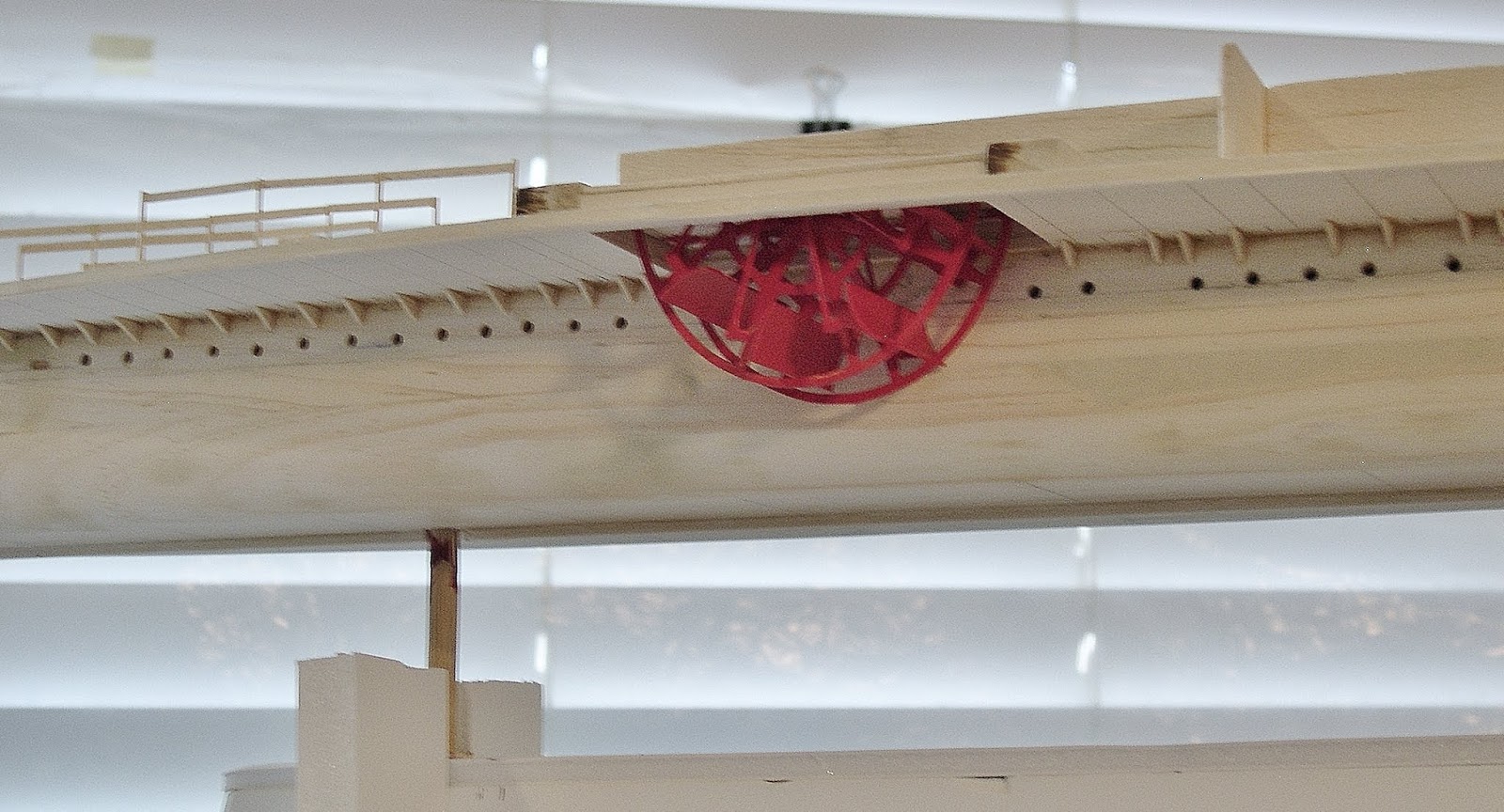
Paddlewheels are usually the second feature addressed on these steamboats, due to the fact that errors can occur within spacing between hull and main deck guards. These feathering wheels are made solely of basswood.


The third feature of the build are the stacks which determine the height of each deck in proportion to the vessel's length. This procedure has given accurate models...even if scales are miscalculated.  From here, I move on to the knees and strakes beneath the main deck -making sure every piece of wood is  aligned properly. If off by 1/16 inch the entire project is ruined and can't be corrected.

The next two images show the knee and strake system...


 The next step of the build is planning the deck layout. Two different versions were made, so careful   attention had to be centered on the doors and cabin arrangements. Changes were made in these areas   and proper alignment of these features will guarantee proper spacing of windows and rails   throughout the entire build. The plans are not absolute (which I learned years ago when pursuing the   first HENDRICK HUDSON model). It was by far the best model ever made, but there were flaws   based on the architectural drawings of those times.

With the fleet of steamboat models to my credit, I wanted to make sure this 100th model was my very best.


            After mapping out the interior main deck with balsa compartments, the bass cabins are next to be addressed -followed by the chock, kevel, cleat and rail systems. This now present the build for the entire model.

As I worked on the model for several weeks, I paid much attention to HENDRICK HUDSON's superstructure and the international flags that graced her staffs over the hurricane deck. I and the Collector discussed this in length -and basically used the references he provided, along with the notes of Mr.Van Olcott (formerly of Princeton, New Jersey) and Herman Boyle (formerly of Kingston, New York). Both were knowledgeable concerning the Day Line and both had references that helped get the accuracy of the flags in correct order.

From photos, only ten cultures were celebrated in the Hudson Valley; but the vessel only carried eight staffs -so the two remaining flags were probably rotated at different occasions. However, the legacy of the Hudson River Day Line was that it supported all peoples of the valley, regardless of heritage.


Photo of HENDRICK HUDSON steaming past Coxsackie flying the international flags circa 1912. This was printed from a glass plate by Herman Boyle c.1983


                                 Another view of the balsa compartments...


This photo image show the compartments supporting the main deck cabin area and stanchions. Everything is perfectly aligned as a result. This partial view of cabin work took approximately five full days to finish.


So not to mar the hull that has been painted and treated, I hold tissue between it and my hand while carefully cutting away excess paper that enclose the cabin acetate windows. The paper covering is layered for each deck so that the windows are shown to perfection without dust or debris. Since sliding doors are usually open, these are lightly taped while I finish the cabin(s)...The tape is removed after the deck is completed -working this process with each deck application.


Stern main deck cabins being painted while the paper covering is turned back for adding the acetate windows. The balsa compartments and inner stanchions are painted a deep grey so to obstruct any viewing of adhesion around the windows. Sliding doors are then placed, followed by cabin painting  to also divert attention to the interior windows. Finally the paper covering is glued to the cabins for easier placement of the saloon deck.


 Port profile showing the sleek and graceful lines of Day Line steamer HENDRICK HUDSON. This work in progress photo salute all the writings concerning this vessel. She was, in fact, beautiful and was a luxury to river travel at a cost of nearly one million dollars at the time of her build. She had an advertised length of over 400 feet and was licensed to carry 5,500 passengers.

Art was commissioned for interior decoration. Murals depicting Henry Hudson's HALF MOON, Washington Irving's home, the Senate House at Kingston, and the Capitol at Albany were part of the interior displays. She was, in fact, New York's finest Dayliner.


This port bow view shows the steady progress of construction. There is much more to reveal in Part Two of this build; that along with exceptional detail to follow. All my models (past and present) are uniquely one of a kind. They are worth viewing ; if not for the beauty then for the detail.

The Hudson Valley has many hidden gems, especially the steamboat models which is available to any discerning collector.

Commissioned work can be honored for any and all Hudson River steamboats. These are fine, one of a kind models that accurately define the vessel as it appeared at any given time of its career. For contact please email: Caseships@yahoo.com or call 1-774-757-7137 for details. To view my work and credentials please visit https://www.linkedin.com/in/rexstewart and https://youtube.com/c/RexStewartoriginals

Thank you for viewing!


Wednesday, March 20, 2019

FRANCIS SKIDDY c.1852 - A Hudson River Legacy...Part Two/ Rex Stewart

   
                            Starboard bow profile highlighting the Union and American flags as
                            they appeared on the FRANCIS SKIDDY during her maiden voyage
                            that summer of 1852.


My work has always been regarded by many notables for being historically accurate; particularly those steamboats that operated throughout New England and the much-heralded Hudson River Valley. In my line of work, I feature this prolific model that I modified from plans originally drafted in 1985.

This second part series focus on both the build and the vicinity where the collector of this model resides. There's no question he has amassed some of the most accurate steamboat models in the Hudson Valley today. But what strikes me as 'intriguing' is his timing in acquiring them and his effectiveness in showcasing quality pieces that many New York State museums don't have in their collections.

As a native New Yorker, born and raised in Albany, New York, I was fortunate to become part of the maritime fabric relative to both Hendrick Hudson's HALF MOON design and the steamboats that operated on the Hudson River. In both genres I realized I had the opportunity to explore and expand my research -associating with those who had strong and affluent ties to the river. Over the years, because of this association, I became connected to various towns and cities up and down this waterway -with Newburgh being the latest discovery to the list.                                                                                                                                                                                                                               
 

                     Plan modifications revised in red ink for those highlighted areas concerning the
                     hogframes, smokestacks and trusses. Also modified were boilers from photos I
                     used relative to the Kingston steamboat THOMAS CORNELL.


.

                            Close-up view featuring opened sliding door (starboard) at saloon cabin
                            with rigged lifeboat...Inside, I made custom patterned carpeting to simulate
                            a detail commonly featured on these vessels during those times.

Much talk traveled on the river from New York City to Albany, New York during the 1840s about a massive steamboat that would soon join the fleet of heralded steamers operating on the Hudson. Many businessmen, and mariner alike, were contemplating this vessel. It would be the first of its kind anywhere.

At the shipyard of George Collyer in New York City, the keel was laid in 1850 for the large dayboat. The following year, under the scrutiny of draftsmen, businessmen and investors, the wood hull and superstructure began to take form...FRANCIS SKIDDY was now becoming a reality.


                        In this photo the author carefully inspects the detail about the paddlebox
                        which include the miniature mural painting of the Hudson Highlands.


FRANCIS SKIDDY began trips in June of 1852. She was a steamboat of meticulous design and grandeur -the largest and finest vessel of the period. By all standards she was considered the zenith of steamboat architecture and the first four-stacker to make such an appearance. Her cabins were spacious -being finished in polished mahogany for which steamboats of this era was noted. The main cabin was in the hull, extending the entire length; and dining tables were made to seat 500 people.

Aside from these accommodations, FRANCIS SKIDDY was a dayboat which meant speed was a dire factor for her success. She made good on her performance between New York City and Albany by arriving at six landings on the 146 mile route in a record 7 1/2 hours. Her travel started from New York in the morning to Albany -returning back to the city at night.


                   Starboard deck overview show completion of hogframe, tierod and smokestack
                   piping systems...Also on this deck between the paddleboxes, a small portion
                   of the roof is left unpainted. This area will house the A frame that will
                   support the walking beam engine and its various pistons and crankshaft.
                 

                      The author's detailed replica of the FRANCIS SKIDDY walking beam
                       engine based on the plans provided by the late Everett C. Britz. He was a
                       New York businessman and avid collector of steamboat memorabilia. The
                       plans for this engine were drafted by the students of Rensselaer Polytechnic
                       Institute when the SKIDDY was docked at Troy, New York as a nightboat.
                       Mr. Britz served on R.P.I.'s college board during the 1980s and remained
                       a serious collector of my models; one, being this piece he commissioned
                       in 1987.


Those who witnessed this awesome steamboat, whether shoreline or in river passing attested the fact that she was very spacious and a fine craft in artistry. Her performance was first rate as a large vessel. She was wide and long. Her length was 322 feet and she carried a hull beam of 38 feet. Her depth of hold was 10 feet and 4 inches while her water draft was listed as 5 feet 6 inches.The large vertical beam engine she housed was built by James Cunningham and Co. Her four impressive boilers and 40 foot paddlewheels which carried 24 buckets to each wheel were built by John F. Rodman out of New York City.

For a period of three years FRANCIS SKIDDY operated as a dayboat, being celebrated by artists and writers, alike. She was a favorite to the general public. However, her career was short-lived, as she was removed from service and greatly altered to become a nightboat. Instead of Albany being her upstate port, she was docked further north at Troy, running at different periods with the steamboats COMMODORE, HENDRICK HUDSON, RIP VAN WINKLE and C. VANDERBILT.

On the night of November 5, 1864 while travelling southbound, she ran ashore at Staatsburgh and sunk. The hull was later broken up and the engine was placed in the new steamboat DEAN RICHMOND which docked at Albany.

Here, we have a history concerning one of the great steamboats of Hudson River lore, but equally exciting, we now have accurate models that depict how these vessels appeared in their heyday of service. The remaining data of my contribution to this history is not to rewrite what was already written; but rather take the history of these vessels to another area that has rarely been touched. That area are these one of a kind replicas which have rarely been seen in the collectibles market.


                             View of the hurricane deck from port stern as the model progress.


                     Another port view from the stern showing the interesting and symmetrical designs which was typical for many large steamers of the day; especially the tie rod and cable patterns about the hog frames, stacks and masts.     


                                             Closeup detail of the stack, flags and cables...                                           

                               
                       Finding the detail work satisfactory in both construction and finish of the
                       hurricane deck, I proceeded to work on the miniature lifeboats (to scale) 
                       from a solid piece of pine -using my custom templates to assist. Notice the 
                       miniature oars on top of the Kennedy half dollar.


                   My next approach was the pilothouse, but only after inspecting and evaluating
                   the saloon deck details. As with all the superstructure, carving panels around the
                   windows was painstakingly time consuming. Most challenging was to avoid
                   cutting too deep into the wood -as this would cause paint to seep into the crevice
                   and mar the simulated windows.


                                                  Detail close-up of finished pilothouse...


                The next step of the build would now be the walking beam engine which would
                be the final finish to the project -and one which is most tedious due to all the small 
                pieces required to make it. Here, I re-work the plans so that the positioning of the 
                engine is accurate. And since it will be entirely of wood no error can be made.


                     Shown is the work in progress of the A frame and completed engine.                                 


The beginning process showing the finished steam valve system and the early build of the
          cylinder piston rods for the engine.                                                                                         


                                  The A frame takes form...                                                                                                                                                                                                                                                                 
   
                                     Port view close up of finished walking beam engine.                                          


                  Deck view of beam engine from starboard. The complete build of this intricate work 
                       took approximately five days.                                                                                             


Head-on bow view showing the beauty and sleekness of steamboat FRANCIS SKIDDY during her first appearance in 1852. One could only imagine what people saw when she arrived and departed  from those landings.                                                                                                                                                  


                       Another head-on bow view (from starboard) of the FRANCIS SKIDDY.                         


                         Steamboat model FRANCIS SKIDDY c.1852 - port profile overview                            


                         Steamboat model FRANCIS SKIDDY c.1852 - starboard profile overview                  

As I'm about to come to a close, I reflect on how many have supported my work over the years. I have been very fortunate to meet outstanding individuals who have given me the best of their hospitality, friendships, and references. My gift to them (and others) have been to pay it forward by remaining in this genre. Again, I've said it many years ago; and I continue to say it "that we are not islands, but people who need each other for the betterment of one another." So is the case here.

There are a few more images to post, but I must give a thumbs up to Newburgh, New York and the stellar hospitality I have received from the collector who commissioned these works. A thumbs up to those from that area who provided great service to us at their waterfront restaurants. To the law enforcement officer that assisted my personal and professional pursuits via social media; and lastly, to several historians who unselfishly shared their expertise on the city and region relative to it's maritime and citizens. This has been a great 40 year journey... Not just with commissions, but in the projection of knowing we have a Society that still appreciate history -at all levels and all genres, especially the maritime.

Now to close with the remaining images...


         Francis Skiddy painting dated 1859 by noted maritime artist James Bard. 
        Many of my  steamboat models were fashioned around what available paintings 
     were attainable to assist my blueprints. Because of my drafting skills (which I 
      developed as a teenager), former curators and antique dealers considered 
      such plans to be the most accurate and the best in New York State.                                                    

                       Port profile based on the above image of the 1859  Bard painting.                                     


                      Starboard profile (in reverse) based on the James Bard painting.                                      


A view looking south through the northern gateway of the Hudson Highlands from the waterfront pier at Newburgh, New York. The pier which runs along the revitalized commercial area of the city, has a unique array of restaurants that host fine food and people. It bustles year round -as this photo was taken by our daughter, Rexavia, during a brisk late morning in January. We were there to deliver the steamboat model to the Collector.

The Hudson Highlands is the feature painted on the paddleboxes of famed steamboat FRANCIS SKIDDY. This location of waterfront accommodated the citizens with both ferry and steamboat service of which the SKIDDY was one of them.


                   Window view from the Collector's home showing the town and hills of Beacon,  
                New York. With the beautiful steamboat paintings he has to accent the models, this 
                view is honorable.                                                                                                                      


                          Library Parlor... 

Here, in between the sitting area are featured two prolific steamboats I built while residing in New England. On the east bookcase sits the renowned steamboat ALBANY as she appeared when first built; and on the west case the MARY POWELL is featured -also in her original livery... Throughout his home, these thoroughly researched (and carefully planned) models accent areas where the visitor will follow the history of Hudson River steamboating from its early years to its final closure with ALEXANDER HAMILTON. 


                                          Midship view details from starboard...                                                              


With each commissioned model, I'm always asked to provide a custom case. Usually, my cases are made with simplicity. The case should never be so attractive that it 'fights' with the model. The case is there to protect it and keep the model as the 'showcase'...As a result of this principle, my clients have chosen to work with me -and their colleagues work with me because they view the model and lose themselves in the details...as it should be.


When custom making my cases, I also produce my own stains...something I learned while exhibiting in the antique venues at Brimfield, MA years ago. My work is contemporary, but much of it carry the 'antique' flair which accent a unique blend of presentation which is "traditional -contemporary". My models fit into this category, along with my sculptures. Also, many of my past work carry handscripted  wooden plaques as shown in this image.                                                                             


This concludes the blog on FRANCIS SKIDDY. I appreciate my viewers and look forward to presenting more subject matter on those prolific steamboats that ran on our Hudson River. Again, I relish the fact that I can still produce them in my maturity...thanking all of you for being part of the legacy. 

Commissioned work can be honored for any and all Hudson River steamboats. These are fine, one of a kind models that accurately define the vessel as it appeared at any given time of its career. For information please email Caseships@yahoo.com or call 1-774-757-7137 for details.

To view my work and credentials please visit https://youtube.com/c/RexStewartoriginals 

Thank you for viewing!